

What Are IT Managed Services? A Guide for Companies in Japan

Introduction: Beyond the Break-Fix Model
If you’re managing a business in Japan, you’ve probably experienced this: a server goes down during peak hours, your team scrambles to find the problem, and you’re left wondering how to prevent it from happening again.
This is the reality of traditional “break-fix” IT support — reactive, unpredictable, and often expensive. But there’s an alternative that’s becoming increasingly common among international companies operating in Japan: managed IT services.
Managed Service Providers (MSPs) take a fundamentally different approach. Instead of waiting for problems to occur, they continuously monitor your systems, perform preventive maintenance, and resolve issues before they impact your business. For companies navigating Japan’s unique IT challenges — from bilingual support needs to local compliance requirements — this proactive model is proving more sustainable than building and managing IT capabilities internally.
This guide explains what managed services are, how they work in the Japanese market, and whether they might be right for your organization.
What Is an MSP?
A Managed Service Provider is an external team that takes ongoing responsibility for your IT operations. Unlike traditional IT support companies that respond when you call with a problem, MSPs work continuously in the background — monitoring systems, applying updates, managing security, and fixing issues before they affect your business.
Think of it this way: traditional IT support is like calling a mechanic only when your car breaks down. An MSP is more like a maintenance service that regularly checks your vehicle, changes the oil, and catches problems early so you rarely experience breakdowns at all.
In Japan, MSPs typically provide:
- 24/7 monitoring of servers, networks, and business applications
- Remote and onsite technical support in Japanese and English
- Security management and threat monitoring
- Regular system updates and maintenance
- IT planning aligned with your business goals
- Compliance support for Japanese regulations
For international companies, this local partnership bridges the gap between global IT standards and Japan’s unique business environment.
Who Uses Managed IT Services in Japan?
MSPs aren’t just for large enterprises. In Japan, companies of all sizes partner with MSPs when they experience:
Frequent IT disruptions — Systems going down regularly, affecting business operations and customer service
Hiring challenges — Difficulty finding bilingual IT staff in Tokyo, where unemployment for IT professionals is under 1% and qualified candidates command premium salaries
Multiple locations — Retail chains, hotel groups, or companies with branch offices needing consistent IT support across Japan
Compliance concerns — Increasing requirements around data protection, cybersecurity, and industry-specific regulations
Growth plans — Expanding operations and needing IT infrastructure that scales without major capital investment
Whether you’re a 50-person subsidiary or a 500-employee retail chain, managed services can be tailored to your current needs and scale as you grow.
Why Japan’s IT Landscape Is Different
Managing IT in Japan presents challenges that catch many international companies off-guard.
The talent problem is real. If you’ve tried hiring IT staff in Tokyo recently, you know the challenge. Qualified candidates are scarce, salary expectations are high, and turnover is increasing as companies compete for the same talent pool. A single cybersecurity engineer can cost ¥10-15M annually — and that’s if you can find one who’s bilingual and available.
Regulatory requirements add complexity. Japan’s Act on the Protection of Personal Information (APPI) functions similarly to GDPR — think data protection requirements with Japanese characteristics. It has specific requirements for how businesses handle personal data, with penalties for non-compliance. Cross-border data transfers require careful navigation, and you’ll need to understand concepts like ‘designated anonymized information’ and ‘personal identification codes’ that don’t map cleanly to Western frameworks.
Business culture matters. Japanese business relationships operate differently than in other markets. Expectations around service precision, communication style, vendor continuity, and problem escalation require local understanding. A support team that doesn’t grasp these cultural nuances can create friction, even if they’re technically competent.
Infrastructure is hybrid and complex. Many Japanese businesses run a mix of legacy systems and modern cloud infrastructure. Point-of-sale systems, inventory management, and customer databases often need to integrate with global platforms while maintaining local functionality. This requires specific technical expertise.
These factors make the DIY approach to IT — hiring staff and managing everything internally — increasingly difficult for international companies operating in Japan.
How Managed Services Differ from Traditional IT Support
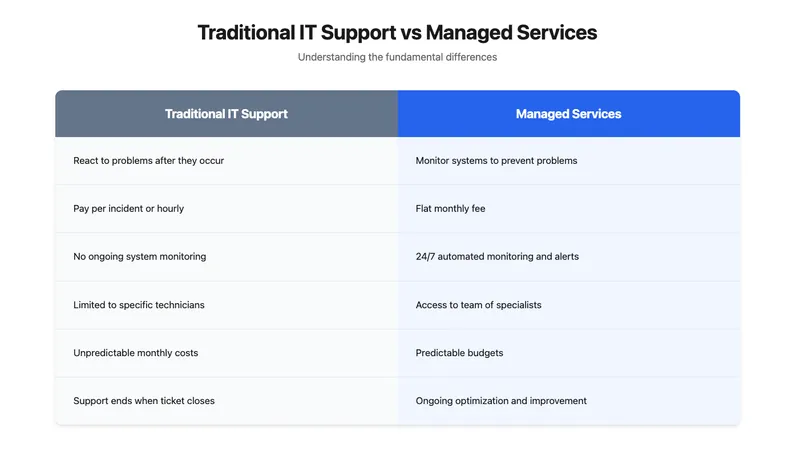
| Traditional IT Support | Managed Services |
|---|---|
| React to problems after they occur | Monitor systems to prevent problems |
| Pay per incident or hourly | Flat monthly fee |
| No ongoing system monitoring | 24/7 automated monitoring and alerts |
| Limited to specific technicians | Access to team of specialists |
| Unpredictable monthly costs | Predictable budgets |
| Support ends when ticket closes | Ongoing optimization and improvement |
Here’s what this looks like in practice:
Traditional support scenario: Your finance system goes down at 3 PM on the last day of the month, disrupting closing procedures. You call your IT vendor, wait for a callback, and lose half a day of productivity while the problem is diagnosed and fixed.
Managed services scenario: Your MSP’s monitoring tools detect unusual database activity at 2:45 PM. An engineer investigates remotely, identifies a failing storage component, and resolves the issue before your finance team notices anything wrong. You receive a summary report the next morning.
The fundamental difference is ownership. Traditional IT vendors are responsible for fixing the specific issue you called about. MSPs are responsible for outcomes — system uptime, performance, security — regardless of what specific problems arise.
Common Misconceptions About Managed Services
Before diving into how MSPs work, let’s address some common concerns:
“MSPs are only for companies without IT staff”
Reality: Many MSPs work alongside internal IT teams. Your staff focuses on business-specific projects and application support, while the MSP handles infrastructure, security monitoring, and 24/7 support. This partnership often makes internal teams more effective by removing the constant interruption of firefighting.
“Managed services mean losing control of our systems”
Reality: You maintain full visibility and decision authority. MSPs execute tasks and provide recommendations, but you approve changes to systems, decide on investments, and set priorities. Most MSPs provide dashboards and regular reports so you always know what’s happening with your infrastructure.
“It’s too expensive for mid-size companies”
Reality: When you factor in salaries, training, tools, and the cost of downtime, managed services often reduce total IT spending. A single critical system failure can cost more than months of managed services fees. The predictable monthly cost also makes budgeting easier.
“We’ll have to completely change how we work”
Reality: Good MSPs adapt to your existing processes and tools. The transition typically happens gradually over 60-90 days, with minimal disruption to daily operations.
How MSPs Typically Work
MSPs offer flexible service approaches depending on your needs:
Full-service partnerships handle all aspects of your IT operations — from infrastructure and security to user support and strategic planning. This works well for companies that want to treat IT as a fully managed utility.
Specialized support focuses on specific areas like network security, cloud infrastructure, or compliance management. This approach suits companies with partial internal IT capabilities who want to outsource functions that require specialized expertise.
Hybrid models complement your existing IT team by handling after-hours support, infrastructure monitoring, or specific technical areas. Your internal staff maintains day-to-day user support and business application management.
The key difference from traditional IT support? MSPs take ownership of outcomes, not just tasks. They’re measured on system performance, uptime, and business impact — not just how quickly they respond to tickets.
Related: Learn what drives managed IT costs and how to compare provider quotes in our Understanding MSP Pricing Models in Japan.
Key Benefits for Companies in Japan
Predictable IT Spending
Managed services turn unpredictable capital expenses into consistent operational costs. Instead of surprise invoices when something breaks or spikes in spending during infrastructure upgrades, you pay a flat monthly rate.
For Japanese subsidiaries balancing local operations with global reporting, this predictability makes financial planning significantly easier. You know your IT costs six months in advance, which simplifies budgeting and removes the need to maintain emergency reserves for IT incidents.
Access to Specialized Expertise
The IT talent shortage in Tokyo is well-documented. Beyond the difficulty of finding qualified candidates, you’re competing with tech giants and startups for the same small pool of bilingual engineers.
MSPs solve this by providing access to teams of specialists — network engineers, security analysts, cloud architects, and project managers — without the recruitment challenges and salary overhead. When you need expertise in a specific area, it’s already available within the MSP’s team.
This is particularly valuable for companies operating in Japan’s retail, hospitality, and finance sectors, where IT requirements span everything from point-of-sale systems to cloud infrastructure to compliance management.
Enhanced Security and Compliance
Japan is tightening data protection and cybersecurity standards. The revised APPI imposes stricter requirements on businesses handling personal information. Industry-specific regulations in finance and healthcare create additional compliance obligations.
MSPs help businesses stay compliant with both Japanese regulations and international standards like PCI DSS and GDPR. Continuous monitoring, regular security updates, and documented processes reduce the risk of breaches and the operational downtime that follows security incidents.
For companies processing customer data across multiple locations, having consistent security practices managed centrally provides both protection and peace of mind.
Operational Consistency Across Locations
For multi-site organizations — retail chains, hotel groups, regional offices — managed services ensure that every location runs with the same reliability and performance standards as headquarters.
Instead of each branch having different IT setups, support contacts, and performance levels, MSPs implement standardized systems and processes. When a new store opens in Osaka, it gets the same monitoring, security, and support as your Tokyo locations.
This consistency reduces operational complexity and makes expansion more predictable. You know exactly what IT infrastructure a new location needs and how much it will cost.
[CTA: Download the IT Infrastructure Assessment Checklist for Japan Operations]
What to Expect: The First 90 Days
Many companies hesitate to engage an MSP because they’re unsure what the transition process looks like. Here’s the typical progression:
Month 1: Discovery and Assessment
Your MSP conducts a thorough audit of your current systems — servers, networks, applications, security measures, and documentation. They interview key staff to understand workflows and pain points. The goal is to identify immediate risks, improvement opportunities, and establish baseline metrics for system performance.
You’ll receive a detailed report outlining the current state, recommendations for improvements, and a roadmap for the transition.
Month 2: Transition and Optimization
Monitoring tools are deployed across your infrastructure. Support processes are established and documented. Staff are trained on new helpdesk procedures. The MSP begins implementing “quick wins” — fixes for known issues that don’t require major system changes.
During this phase, your existing support arrangements typically remain in place as a safety net. The MSP handles new issues while building familiarity with your environment.
Month 3: Steady State Operations
By month three, 24/7 monitoring is fully active, helpdesk operations are running smoothly, and the MSP has resolved initial technical debt. Regular reporting begins, showing system performance trends and improvements from baseline.
Strategic planning discussions begin, focusing on longer-term projects like infrastructure upgrades, security enhancements, or cloud migrations.
Most companies report that the transition feels less disruptive than anticipated. The key is finding an MSP that takes a methodical, well-documented approach rather than rushing to change everything immediately.
How Managed Services Support Business Growth
A well-chosen MSP doesn’t just maintain infrastructure — they help your business scale.
Faster deployment of new locations. Standardized processes and centralized management enable quicker store openings or office expansions. Instead of spending weeks configuring IT systems for a new site, the MSP can replicate proven setups and have everything operational in days.
Better decision-making through data. Regular reporting and analytics turn IT metrics into business insights. You can see patterns in system performance, understand where technology investments have the greatest impact, and make decisions based on data rather than assumptions.
Focus on innovation instead of maintenance. With day-to-day operations covered, internal teams can shift attention to digital transformation projects, improving customer experience, or adopting new technologies like AI and advanced analytics.
The work we’ve done with major retail clients shows this in action. By consolidating multiple vendors into a single managed services partnership, companies have reduced IT costs by 30-40%, improved system uptime to 99.9%, and freed internal teams to focus on customer-facing technology initiatives rather than infrastructure firefighting.
[CTA: Read the case study on how we helped a global retail brand improve operations across 50+ Japan locations]
Is Managed IT Right for Your Company?
Consider managed services if you answer “yes” to two or more of these questions:
- IT issues regularly disrupt business operations
- You lack specialized skills internally (security, cloud, compliance)
- Your IT spending is unpredictable quarter-to-quarter
- You’re planning to expand locations in Japan
- Compliance requirements are increasing
- Your internal IT team is consistently overwhelmed
- You’ve had difficulty hiring qualified IT staff in Japan
- You need bilingual support for international and local teams
- You’re spending more time reacting to problems than planning improvements
Managed services aren’t necessarily the right fit for every company. Organizations with large, well-staffed IT departments and relatively simple infrastructure may prefer to keep everything internal. Companies in highly specialized industries with unique technical requirements may need more customized solutions.
But for international businesses operating in Japan — particularly those in retail, hospitality, and finance — the combination of local expertise, bilingual support, predictable costs, and scalable infrastructure makes managed services an increasingly practical choice.
Common Questions About Managed Services
How much does managed IT cost in Japan?
Pricing varies based on the number of users, complexity of your infrastructure, and level of service required. Most MSPs in Japan charge between ¥15,000-¥35,000 per user per month for comprehensive services. Specialized services like security monitoring or cloud management may be priced separately. The key is comparing this cost against your current IT spending — including salaries, tools, vendor fees, and the cost of downtime.
Can an MSP work with our existing IT team?
Yes. Many companies use a hybrid model where internal staff handle business-specific applications and day-to-day user support, while the MSP manages infrastructure, security, and after-hours support. This partnership often makes internal teams more effective.
What happens if we’re not satisfied with the service?
Reputable MSPs work on renewable contracts (typically annual) with clear service level agreements. If performance doesn’t meet agreed standards, you have documented grounds for discussion. Most MSPs would prefer to address concerns and improve service rather than lose a client, so communication issues early typically leads to resolution.
How do we transition from our current IT setup?
The transition typically takes 60-90 days and happens in phases to minimize disruption. Your current arrangements usually remain in place during the initial transition period. A good MSP will create a detailed transition plan that you approve before any changes begin.
Do we lose control of our systems?
No. You retain full ownership and decision authority over your IT systems. The MSP executes according to your priorities and policies. Most MSPs provide dashboards and regular reports so you always have visibility into what’s happening.
What if our business grows or changes?
That’s one of the main advantages of managed services — scalability. Need to add 20 users next quarter? Open a new location? The MSP can scale support and infrastructure without you needing to hire additional staff or make major capital investments.
Have more questions? Our team offers complimentary 30-minute consultations to discuss how managed services work in Japan — no sales pitch, just honest guidance about your specific situation.
Conclusion: Moving Beyond Break-Fix
If your IT team spends more time reacting to problems than planning for growth, if your costs are unpredictable, or if you’re struggling to find qualified technical staff in Japan, it may be time to consider a different approach.
Managed services shift IT from a reactive cost center to a proactive business enabler. For companies navigating Japan’s complex IT landscape — with its talent shortages, regulatory requirements, and cultural considerations — partnering with a local MSP provides stability, expertise, and the forward-looking perspective needed to grow sustainably.
The question isn’t whether your current IT setup works — it’s whether it positions you for the next three to five years of growth in one of the world’s most competitive markets.
Considering managed services in Japan?
Fusion Systems Japan helps international companies simplify IT operations, ensure compliance, and maintain reliable bilingual support across all locations.
Contact Us